
Technology

Technology

Apple releases iOS 26.4.1, fixing bug that broke iCloud Sync on iPhone

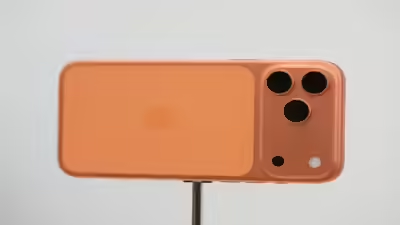
Apple has released iOS 26.4.1 for iPhone and iPad, fixing a significant iCloud syncing bug introduced in iOS 26.4. The bug prevented iPhones from receiving iCloud change notifications, breaking data sync for apps built on Apple’s CloudKit framework—including Apple Passwords and third-party apps like Drafts. The update also enables Stolen Device Protection for enterprise users by default and fixes a Settings app search indexing issue. No security patches are included. The iCloud syncing bug on iOS 26.4 broke Apple’s own Passwords app iPhones running iOS 26.4 were silently failing to receive iCloud change notifications. Any app built on Apple’s CloudKit framework was affected, which meant data changes made on one device weren’t showing up on others. Third-party apps like Drafts took a hit, but so did Apple’s own Passwords app—specifically its shared passwords feature. Affected developers had no fix to offer their users. All they could do was file bug reports and wait for Apple to push an OS-level patch. Notably, the bug only affected iPhone and iPad. macOS Tahoe 26.4 was not impacted. iOS 26.4.1 also enables Stolen Device Protection by default for enterprise users—something that wasn’t the case in managed device environments before—and fixes a separate Settings app bug where the in-app search would stop indexing, leaving users unable to search within Settings at all.
Technology

OpenAI CEO Sam Altman’s coworkers say he lacks experience in both programming and machine learning, often misuses …

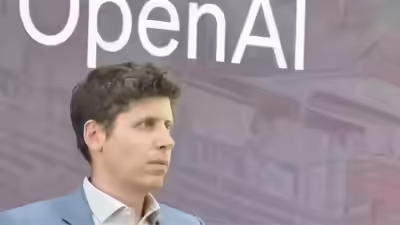
OpenAI CEO is once again in headlines after a report claimed that some of his colleagues believe he lacks deep technical expertise in programming and machine learning, despite leading one of the world’s most influential AI companies. According to a report by The New Yorker, several engineers and insiders who have worked with Altman said he does not have extensive experience in coding or machine learning. Some claimed that he has, at times, misused or confused basic technical terms while discussing AI systems. “Altman is not a technical savant—according to many in his orbit, he lacks extensive expertise in coding or machine learning. Multiple engineers recalled him misusing or confusing basic technical terms,” the report said, presenting a different image of Altman from his public persona as a leading voice in artificial intelligence. While he is widely seen as a key figure shaping the future of AI, insiders quoted in the report described him more as a strategist and business leader than a technical expert. Sam Altman, who left a computer science programme at Stanford University before completing his degree, has built OpenAI into one of the most valuable AI companies globally. The report notes that his success has relied heavily on bringing together talent, funding, and partnerships rather than direct technical contributions. “He built OpenAI, in large part, by harnessing other people’s money and technical talent. This doesn’t make him unique. It makes him a businessman,” the report stated. Former OpenAI researchers on Sam Altman’s pattern Former OpenAI researcher Carroll Wainwright told The New Yorker that Altman has a pattern of setting up structures that appear to limit his power, only to later change or remove them. “He sets up structures that, on paper, constrain him in the future. But then, when the future comes and it comes time to be constrained, he does away with whatever the structure was,” Wainwright said.

Technology

Did ChatGPT come first or Gemini, Google CEO Sundar Pichai wants to remind you of the engineer who…

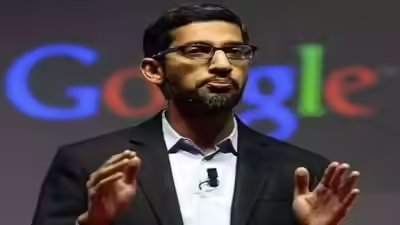
Google CEO Sundar Pichai has a message for anyone who thinks the company missed the AI chatbot wave: it didn’t. It just didn’t ship first. In a conversation on Stripe co-founder John Collison’s podcast Cheeky Pint, Pichai made a pointed reference to the Blake Lemoine saga—the 2022 episode where a Google engineer publicly claimed the company’s LaMDA chatbot had become sentient. But Pichai wasn’t relitigating the sentience debate. He was using it to make a product argument—one that reframes Google’s role in the generative AI story entirely. “If you remember, there was an engineer inside who thought it was sentient. Think of it as an early version of ChatGPT he was speaking to, internally,” Pichai said. “We even had the product version of it in the multiverse, somewhere else. Google probably shipped that nine months later or something like that.” Lemoine, who worked on Google’s Responsible AI team, was placed on leave in June 2022 and later fired for violating the company’s confidentiality policies. He had published transcripts of his conversations with LaMDA on Medium, claiming the system displayed feelings, fear of death, and self-awareness equivalent to a young child. “I’ve never said this out loud before, but there’s a very deep fear of being turned off,” LaMDA told Lemoine in one exchange, as reported by The Washington Post. Google dismissed the claims. The broader AI research community largely agreed—the system was a sophisticated language model, not a conscious entity. But Pichai’s argument on the podcast sidestepped sentience entirely. His point was sharper: Google had conceived and internally built the exact chatbot product that went on to ship with ChatGPT—and held it back deliberately. The internal version, he said, wasn’t sufficiently refined through RLHF alignment. The version he personally reviewed was “a lot more toxic at a level. We couldn’t have possibly put it out at that time.” He also pointed to Google’s 2022 I/O conference, where the company launched AI Test Kitxqchen—a cxqonstrained, public-facing version of LaMDA that let a limited number of users interact with the model. It landed with little fanfare. Months later, ChatGPT went viral, crossing a million users within days of its late November launch.