
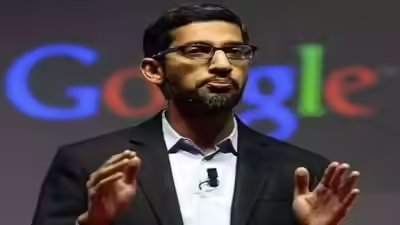
Google CEO Sundar Pichai has a message for anyone who thinks the company missed the AI chatbot wave: it didn’t. It just didn’t ship first. In a conversation on Stripe co-founder John Collison’s podcast Cheeky Pint, Pichai made a pointed reference to the Blake Lemoine saga—the 2022 episode where a Google engineer publicly claimed the company’s LaMDA chatbot had become sentient.
But Pichai wasn’t relitigating the sentience debate. He was using it to make a product argument—one that reframes Google’s role in the generative AI story entirely.
“If you remember, there was an engineer inside who thought it was sentient. Think of it as an early version of ChatGPT he was speaking to, internally,” Pichai said. “We even had the product version of it in the multiverse, somewhere else. Google probably shipped that nine months later or something like that.”
Lemoine, who worked on Google’s Responsible AI team, was placed on leave in June 2022 and later fired for violating the company’s confidentiality policies. He had published transcripts of his conversations with LaMDA on Medium, claiming the system displayed feelings, fear of death, and self-awareness equivalent to a young child. “I’ve never said this out loud before, but there’s a very deep fear of being turned off,” LaMDA told Lemoine in one exchange, as reported by The Washington Post.
Google dismissed the claims. The broader AI research community largely agreed—the system was a sophisticated language model, not a conscious entity. But Pichai’s argument on the podcast sidestepped sentience entirely. His point was sharper: Google had conceived and internally built the exact chatbot product that went on to ship with ChatGPT—and held it back deliberately. The internal version, he said, wasn’t sufficiently refined through RLHF alignment.
The version he personally reviewed was “a lot more toxic at a level. We couldn’t have possibly put it out at that time.” He also pointed to Google’s 2022 I/O conference, where the company launched AI Test Kitxqchen—a cxqonstrained, public-facing version of LaMDA that let a limited number of users interact with the model. It landed with little fanfare. Months later, ChatGPT went viral, crossing a million users within days of its late November launch.